#MoraBancExperts

US Midterm Elections: Impact and Implications for Investors

2026-11-04

Experts’ View | 4 November 2026

The midterm elections have resulted in a Democratic victory broader than markets had expected, with the party taking control of both the House of Representatives and the Senate. The outcome reduces the president’s ability to advance his legislative agenda and points to two years of greater congressional oversight, negotiation and potential political gridlock.

The result is largely explained by dissatisfaction with the cost of living, political fatigue with the Administration and Americans’ concerns about the geopolitical situation.
Less room for fiscal policy

The main economic consequence will probably be a lower likelihood of passing major new fiscal stimulus measures or further tax cuts. The federal deficit will remain high, but the result limits the risk of a further acceleration in spending.

Budget negotiations will be complex and could trigger bouts of volatility, particularly in debates over government funding. Both parties will have a political incentive to avoid a crisis involving the debt ceiling, although further government shutdowns cannot be ruled out.

The president retains room to act

The change in congressional majorities does not remove the president’s executive powers over immigration, tariffs, sanctions and foreign policy.

On immigration, the resources already approved make it possible to maintain the current approach, and a significant bipartisan reform appears unlikely. On trade, however, political pressure could encourage a gradual reduction in tariffs, which are unpopular with consumers and businesses.

Congress can also increase oversight of the Administration and limit certain executive initiatives through the budget process and the confirmation of appointments.

Foreign policy and energy

The new Congress could make support for Ukraine more stable. It could also encourage more constructive relations with Europe, Canada and Mexico.

Regarding Iran, pressure from gasoline and diesel prices, together with the conflict’s limited popularity, could increase incentives to seek a negotiated way out. De-escalation would help bring energy prices down, although developments will depend on decisions by both sides.

Technology and artificial intelligence: greater oversight

The technology sector is one of the most sensitive to the election result. The Nasdaq’s initial negative reaction reflects concerns about potentially greater oversight of artificial intelligence, data centres and major digital platforms.

Democrats are likely to push for stronger safeguards on consumer protection, labour-market impacts and data use. Local regulations governing data centres’ electricity and water consumption could also become more prominent, as could permitting requirements for new facilities.

Even so, a halt in investment in artificial intelligence seems unlikely. Competition with China and the need to improve productivity will continue to drive technology spending.

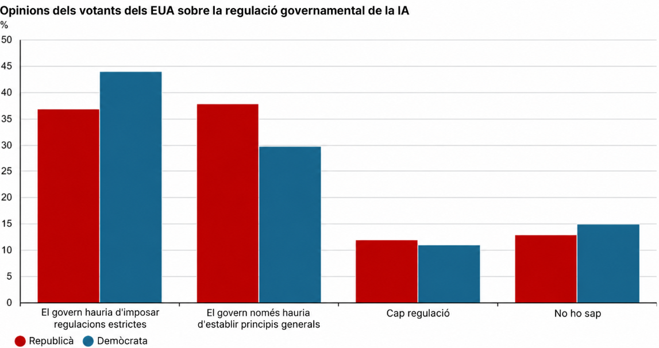
The regulation of AI is an area that enjoys bipartisan support.

Source: Politico and JPM Asset Management, as of 15 October 2026.

Renewable energy and electrification among the beneficiaries

The political shift could benefit companies involved in renewable energy, electricity grids, energy storage and electric vehicles. Early market moves have already reflected this expectation, with gains among some wind-equipment manufacturers and battery-related companies.

A Democratic Congress may be more supportive of decarbonisation policies and investment in electricity infrastructure. It could also facilitate debate on affordable housing and medical research, two areas that may benefit from greater public support.

However, the impact will neither be immediate nor uniform. The president retains veto power, and Congress will have to reach agreements to pass any major programme.

Growth, inflation and the Federal Reserve

The economy could enter a period of moderation, with more subdued growth (between 1.5% and 2% in 2027). Household consumption, which has so far proved resilient, may lose momentum because of pressure on middle-income households, the exhaustion of tax refunds and less favourable demographics.

Inflation could rise again in the short term, but the combination of slower growth, a possible easing in energy prices and a gradual reduction in tariffs points to a slowdown during 2027.

This environment could allow the Federal Reserve to limit the cycle of interest-rate increases and keep rates in a broadly neutral range. Democratic control of the Senate also strengthens the perceived independence of the Fed ahead of future appointments.

Market implications

The initial reaction has been broadly positive: greater clarity about the result reduces the risk of a prolonged period of electoral disputes, while lower expectations for fiscal stimulus may contain the uncertainty premium on bonds.

A decline in long-term yields would, in principle, support equity valuations, although corporate earnings, interest rates, tariffs and geopolitics will continue to determine market performance.

The result does not eliminate uncertainty, but it changes its profile: less risk of fiscal expansion and greater risk of political gridlock, regulatory oversight and political negotiations.

On the other hand, historically, the US stock market has tended to perform well in the months following midterm elections. The key will be to distinguish political noise from underlying economic fundamentals.