
#MoraBancExperts

Technology, oil and interest rates: what moved the markets in July?

2026-08-12

July: Investors take another look at fundamentals

During the month of July, financial markets began to show greater sensitivity to the deterioration of some macroeconomic variables and the persistence of geopolitical tensions in the Persian Gulf. The combination of a barrel of Brent above $90, the rise in sovereign debt yields and doubts about the ability of investments in artificial intelligence to generate short-term returns encouraged profit-taking in some of the segments that had led the increases during the first half of the year.

In equities, the behaviour was uneven among regions and sectors. In Europe, the Ibex 35 advanced 1.6%, the German DAX 2.5% and the Euro Stoxx 50 0.5%. In the United States, on the other hand, corrections were particularly concentrated in the technology sector: the S&P 500 fell 0.1% in dollars, the Nasdaq 100 6.6% and the Philadelphia Semiconductor Index (SOX) fell 20.6%, although it had still accumulated a gain of close to 60% since the beginning of the year. The MSCI World closed the month with a gain of 0.5%, while emerging markets fell 3.3%.
Performance of the main global indices


Índex


País / Regió


Rendibilitat últim mes (juliol)

Rendibilitat des de principis d’any (a 31 de juliol)

S&P 500

Estats Units

-0,13%

9,41%

Nasdaq 100

Estats Units

-6,61%

11,98%

Dow Jones

Estats Units

0,32%

9,20%

Euro Stoxx 50

Europa

0,47%

9,78%

Ibex 35

Espanya

1,60%

14,30%

CAC 40

França

1,26%

4,42%

DAX

Alemanya

2,53%

4,65%

FTSE 100

Regne Unit

3,53%

9,43%

Hang Seng

Hong Kong

13,13%

0,99%

Nikkei 225

Japó

-8,14%

27,86%

MSCI Àsia-Pacific

Àsia Pacific

-1,52%

18,51%

Source: Bloomberg and prepared by MoraBanc

Fixed income also recorded an increase in volatility. The Bloomberg Euro Aggregate fell 1.5% and global euro-hedged debt lost 1.1%. The yield on the ten-year US bond ended the month at 4.7%, while that on the German bond of the same maturity reached 3.2%, in a context of a rebound in inflation expectations and a revision of expectations on interest rates.

Business results remain solid, but market expectations rise

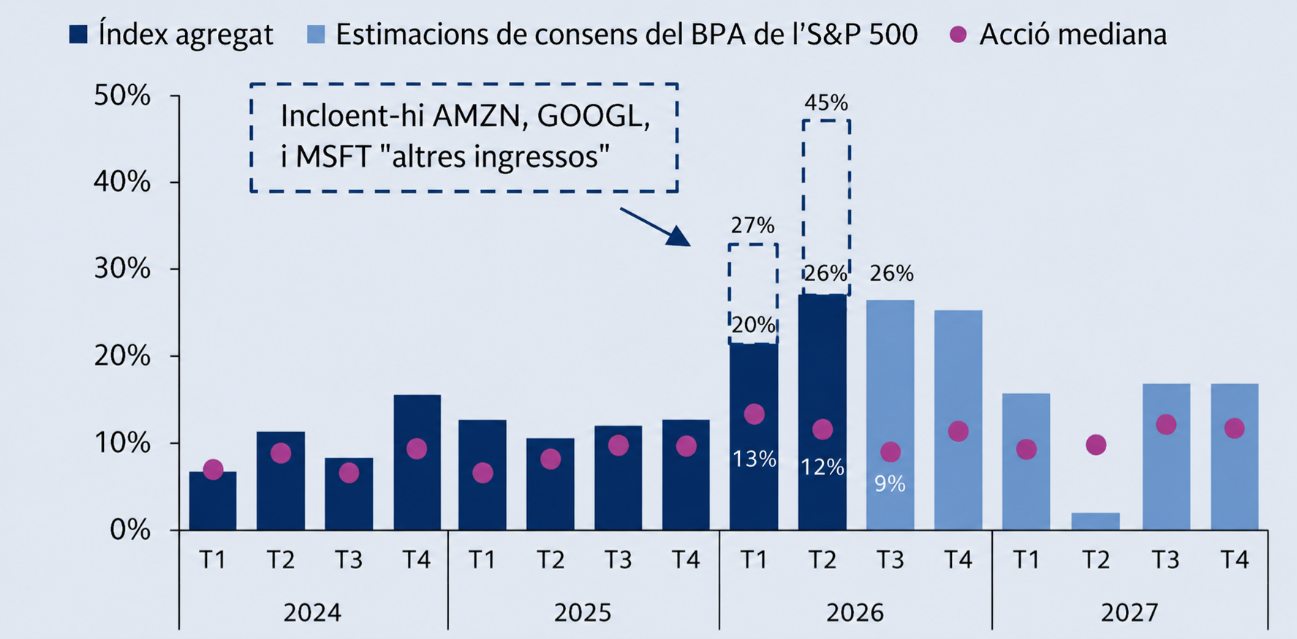
The second quarter earnings season continued to show solid growth in corporate profits. In the United States, earnings per share (EPS) for the S&P 500 grew 45% year-on-year, well above the 22% expected at the beginning of the quarter. Adjusting for non-recurring revenue sources, growth stood at 26%, also above initial expectations. This difference is largely explained by unrealised accounting gains recorded by some large companies, such as Alphabet and Amazon, as a result of the strong revaluation of their stakes in companies such as Anthropic and SpaceX. These extraordinary effects occasionally increased reported profits and gave rise, atypically, to positive EPS surprises of more than 200%.

This strength was not concentrated solely in large companies. The EPS of the median company in the S&P 500 grew 12% year-on-year, above the 9% forecast by consensus at the start of earnings season. This behaviour points to relatively widespread profit growth among the companies in the index.

At the same time, large technology companies maintained high levels of investment in data centres, semiconductors, computing capacity and other infrastructure linked to the development of artificial intelligence. Despite the solid results, the market reaction was more moderate than in previous quarters. After the strong accumulated revaluations, especially among companies linked to artificial intelligence, investors began to demand more evidence on the ability to transform these high levels of investment into sustained profit growth.

Year-over-year growth in earnings per share (EPS) for the S&P 500

Source: GS Global Investment Research and GS Asset Management.

Data as of 5 August 2026.

Central banks remain cautious in a still uncertain environment

The evolution of inflation continues to be one of the main determinants of monetary policy, despite showing different dynamics between the United States and the euro zone. In the US, the CPI moderated significantly in June, to 3.5% year-on-year, from 4.2% previously and below the 3.8% forecast by consensus. In the euro zone, on the other hand, the preliminary data for July placed inflation at 2.9% year-on-year, one decimal above the previous record and in line with expectations. The rise in energy prices, however, continues to be one of the main sources of uncertainty, due to the risk that it could be transferred to other components of the price index and slow down the convergence of inflation towards the central banks' targets.

In this context, the Federal Reserve maintained the target range for interest rates at 3.50%-3.75%. The institution noted that economic activity continued to expand at a solid pace, while inflation, despite recent moderation, remained above the 2% target. The decision also showed greater internal division, with three members of the Federal Open Market Committee in favour of increasing rates by 25 basis points.

In the eurozone, the European Central Bank also kept rates unchanged in July, after the 25 basis point increase agreed in June. The slight acceleration in inflation maintains caution about the evolution of prices, especially given the risk that the increase in energy prices will be transferred to other components of the index.

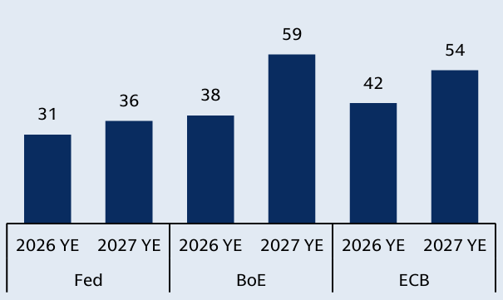
Market expectations on the cumulative change in Fed, ECB and BoE interest rates from current levels

Source: GS Global Banking & Markets and GS Asset Management.

Data as of 29 July 2026.

Japan regains prominence in currency markets

One of the most significant episodes of the month occurred in the foreign exchange market. After the yen approached 164 yen per dollar, the weakest level in 40 years, Japanese authorities intervened on 30 and 31 July to stop its depreciation. According to Goldman Sachs estimates, transactions are believed to have reached between 11.5 and 13.5 trillion yen in just two sessions, an intervention of considerable magnitude. Furthermore, the intervention on 31 July was carried out in coordination with the United States, for the first time in 15 years.

The weakness of the yen is due to several factors, including the wide interest rate differential with the United States, uncertainty about the Bank of Japan's pace of monetary normalisation, and fiscal and energy risks. In this context, intervention allows us to act directly on the currency without necessarily accelerating rate increases, while the underlying evolution of the yen will continue to be linked to the interest rate differential and inflation prospects.

Geopolitics continues to influence the evolution of energy prices

Tensions in the Persian Gulf once again affected energy markets in July. Brent oil advanced 23.6% and exceeded $90 per barrel, while European natural gas increased 36%.

The evolution of the conflict in the Strait of Hormuz continues to have a direct impact on the global energy market, given that it constitutes one of the main routes for maritime transport of oil and gas. After the de-escalation observed in June, the rise in tensions in July once again put upward pressure on energy prices and increased their volatility.

This movement also has implications for inflation prospects. The rise in the price of oil and gas raises the energy costs of companies and households and can gradually be passed on to other components of price indices. This effect is especially important in Europe due to its greater dependence on energy imports.

As for other assets, gold advanced 1% in dollars, to $4,046 per ounce, while the euro appreciated 0.9% against the dollar, to $1.1527 per euro.