
#MoraBancExperts

The markets have regained their confidence: what might we expect now?

2026-07-08

June: back to the basics

June has been marked by a clear uptick in investor sentiment. The de-escalation of geopolitical tensions in the Middle East, on the heels of the preliminary agreement between the United States and Iran to reopen the Strait of Hormuz, has significantly trimmed the perception of risk in the markets. This has led to a sharp correction in the price of oil, easing the spectre of inflation and bolstering the prospects of growth in energy-importing economies.

In this context, investors have shifted their attention back to economic and business fundamentals. Fixed income performed well thanks to the fall in sovereign debt yields, while equity continued to find support in sectors linked to artificial intelligence, especially in companies involved in semiconductors, agent memories, data centres and other infrastructures necessary for the development thereof.

The gulf between the monetary policies of the main central banks also persisted. The Federal Reserve opted to maintain interest rates, while the European Central Bank raised them by 25 basis points in the face of stubborn inflation.
An economy that remains resilient

MoraBanc experts continue to have a moderately positive view of the markets. Although the economic context continues to be plagued by uncertainty, the geopolitical de-escalation and strong economic activity have kept the market a favourable scenario for the markets.

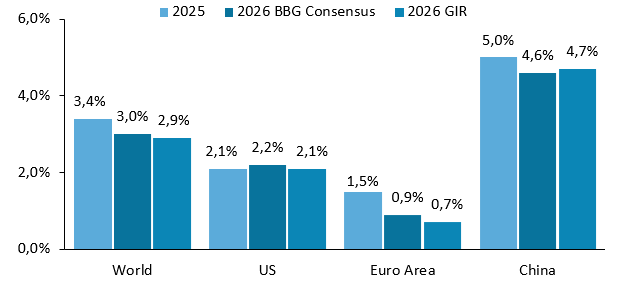
Global growth continues to be buoyed by several structural factors, including the strength of private sector balance sheets, AI-linked investment and the fiscal stimulus being implemented in different regions. Despite this, the evolution of energy prices will continue to be a determining factor for the rate of growth over the coming months.

Expected real GDP growth in 2026

Source: GIR Goldman Sachs

Inflation and interest rates: central bank prudence

Despite the moderation observed in June, inflation continues to be one of the main focal points.

In the United States, the impact of tariffs on prices is expected to gradually wane, although rising energy prices could apply some inflationary pressure in the short term. In Europe, on the other hand, energy dependence makes the region particularly sensitive to any rebound in oil prices.

This scenario explains why central banks have taken a cautious mindset. The Federal Reserve could delay future rate cuts, while the ECB affirms a more restrictive stance (after having already raised rates at the last meeting) given the persistent inflation.

Artificial intelligence continues to lead the opportunities

AI continues to be the main driver of market growth.

Corporate earnings are returning favourable performance, driven by AI investment, resilient demand and improvements in corporate efficiency. Although valuations today are more demanding than at the beginning of the year, they continue to be underpinned by solid expectations of profit growth.

In the United States, market leadership continues to be supported by solid business results and the momentum of investment in artificial intelligence, which is increasingly spreading to more sectors of the economy. Consumption remains resilient and companies have demonstrated their ability to preserve their margins despite rising costs. However, US market values remain quite demanding, which limits some of the potential for revaluation and makes it particularly important to keep close tabs on the evolution of corporate profits and the ability to monetise AI investments.

Europe gains appeal

Europe is also offering positive arguments within the current scenario.

Market prices continue to be more attractive than in other developed markets and profit expectations are progressively improving, especially in industrial and commodity-related sectors. In addition, spending on infrastructure and defence is helping to bolster the region's growth prospects.

However, Europe's energy dependence remains one of the region’s main factors of vulnerability to possible geopolitical tensions.

Japan and emerging markets maintain potential

Japan continues to reap the benefits of structural reforms, better corporate governance and initiatives aimed at increasing shareholder returns. This set of factors provides the basis for holding favourable prospects for the Japanese market.

As for emerging markets, they continue to present opportunities thanks to their role in the artificial intelligence value chain. Taiwan and South Korea are some of the main beneficiaries, while India maintains good growth prospects in the medium term. China, despite facing persistent structural challenges, is reaffirming its strong commitment to leading the development of artificial intelligence through its own technological infrastructure that is set to strengthen its competitiveness and industrial growth.

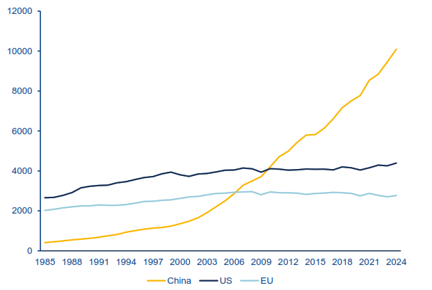
Electrification as a pathway to technological leadership

Total electricity production (TWh):

comparison between China, the United States and the European Union

Source: Allianz Global Investors, Ember, Energy Institute – World Energy Statistical Review, March 2026

Fixed income: greater appeal, but managed selectively

After the heavy volatility of recent years, fixed income has regained interest thanks to current levels of profitability.

However, the view on public debt remains a cautious one. We believe that government bonds offer a less attractive risk-return ratio, especially given the high duration risk and growing public deficits, especially in the United States.

On the other hand, our analysis continues to show a relative preference for corporate credit over sovereign debt, both in Europe and the United States, always through active management that provides for a selection of companies with the best fundamentals in an environment that is still markedly volatile.

A constructive vision ahead, never losing sight of the risks

The current context continues to favourable towards risk assets, thanks to the solidity of corporate profits, the prominence of artificial intelligence and the resilience of the global economy.

Even so, the attitude towards risks that can still condition the markets, such as the evolution of geopolitical tensions, the behaviour of energy prices, inflation or certain private credit segments remains a cautious one.

In this environment, diversification, a careful selection of investments, and active management continue to be the most appropriate tools to face a market that, despite presenting its opportunities, continues to require discipline and a long-term vision.