
#MoraBancExperts

Why is the price of oil falling if the world is still plagued by uncertainty?

2026-06-08

In the wake of months beset by geopolitical tensions in the Middle East and the uncertainty regarding traffic through the Persian Gulf, numerous analysts expected oil prices to remain high. However, the reality has been different, as the price of oil has dropped by nearly 22% from the levels recorded in late March.

The question is inevitable: what’s happening in the oil market? The answer lies not so much in the supply as in the demand, which is showing increasingly obvious signs of weakness.
From a fear of shortages to the normalisation of the markets

During the early months of the year, the geopolitical tensions led companies and investors to accumulate oil as a precautionary measure. In view of the possibility of supply disruptions, many companies expanded their stocks and the financial markets intensified their bullish commitment to crude oil.

Now, however, the situation has changed. The expectations of greater stability in the region have reduced the need to build up reserves and the process is being reversed. In other words, the market is shifting from a storage phase to a destocking one, a trend which is helping to bring down prices.

Global demand displays signs of fatigue

Beyond this temporary effect, the factor worrying analysts the most is the weakness of end-user demand.

The main energy agencies have revised their consumption forecasts for 2026 downwards. This revision reflects an increasingly visible reality, namely that consumers and companies are reacting more intensely to the rises in energy prices.

In particular, the indicators point to lower activity in two key segments: aviation and the petrochemical industry.

Fewer flights and less industrial demand

Aircraft fuel consumption continues to lie below its usual levels. Despite the tourism industry bouncing back in many regions, global demand for kerosene remains weak, a sign that international travel is yet to recover at its expected pace.

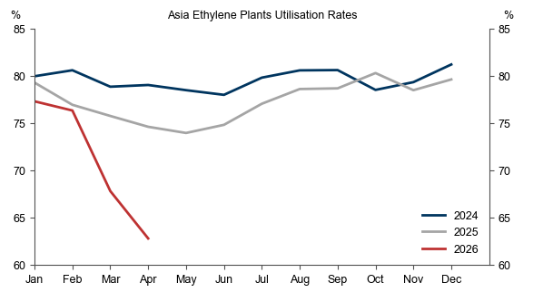
However, it’s the petrochemical industry which is displaying the most worrying signs. In Asia, plants producing ethylene (a basic component for making plastics) are operating well below their normal levels. In China and Japan, declines can also be observed in several chemical sectors, suggesting lower industrial and manufacturing activity.

This behaviour is particularly relevant, because petrochemicals constitute a significant part of the structural growth of global oil demand.

The utilisation rate of ethylene plants in Asia has fallen by 14 percentage points since February, indicating weak demand for petrochemical feedstocks.

Source: Goldman Sachs Global Investment Research

The transformation of transport speeds up the changes

Oil consumption appears to be more price-sensitive nowadays than in the past.

This is because consumers have other alternatives. The expansion of electric vehicles, especially in China, the development of urban public transport and the consolidation of remote working are gradually cutting down on dependence on traditional fuels.

China is probably the most obvious example. Fuel sales have undergone a sharp fall, while underground travel, rail transport and electric vehicle charging are on the rise. This structural change could have significant consequences for the energy market in the coming years.

Consumption is also falling in Europe

The most recent data show that fuel sales in several European countries have undergone significant downturns. The price rises at petrol stations and a greater awareness of energy efficiency are contributing to a slowdown in consumption.

This phenomenon reinforces the idea that global demand could grow at a lower rate than the one expected just a few months ago.

What does this all mean for the price of oil?

Despite the recent correction, the market remains exposed to two opposing risks.

On the one hand, any further interruptions to the supply from the Middle East could lead to new surges in prices. On the other, if the slowdown in global demand is confirmed, oil could continue to find it difficult to recover the levels recorded in spring.

The foregoing suggests a more balanced scenario than the one many investors anticipated at the beginning of the year; the upside risks continue to exist, but the downside ones linked to demand are much more relevant now.

A reading of the situation beyond oil

More than just a story about energy, the current evolution of oil prices is also a window into understanding the state of the world economy.

Lower consumption of industrial, petrochemical and transport fuels is often reflected in more moderate economic activity. The evolution of the demand for energy will therefore continue to be one of the most followed indicators by the markets over the coming months.

The message is clear for investors: geopolitics remains important, but it will become increasingly necessary to closely monitor the demand indicators and structural changes that are transforming global energy consumption.