
#MoraBancExperts

On the threshold of 2026: what can we expect from the markets next year?

MoraBanc 2025-12-05

2025 has been a year characterised by optimism among investors. Despite geopolitical risks within the context of a transitional monetary policy, the main asset classes have maintained their positive behaviour, with all-time highs in terms of equity, high flows towards risk assets and healthy demand for alternative assets such as gold.

The stock markets remain at very high levels, reflecting investor confidence within a scenario of stable growth and controlled inflation.

Despite the above optimism, cross-sectional volatility is still a distinctive feature of the current markets. In the United States, the concern is based on the high valuations and the sustainability of public debt, while in Europe attention is focused on the expansionary fiscal policy and its potential to reactivate growth.
United States: resilient growth but question marks with regard to sustainability

The US economy continues to display remarkable resilience, supported by a combination of expansive taxation and a stable labour market. However, there are increasing signs indicating a certain slowdown in activity and the risk of a spike in inflation if public spending and the stimulus programmes aren’t reduced. For the time being, the market forecasts are for more rate cuts than those that are likely to occur.

The Federal Reserve will find it difficult to apply three cuts in 2026, as the balance between growth, inflation and fiscal policy remains fragile. 

Europe: an expansionary fiscal policy and selective opportunities

In the eurozone, the combination of expansionary fiscal policies and a monetary policy that has begun to ease is creating a favourable environment for economic activity.

Although the growth is more modest than in the United States, the improved public spending and interest rate stability could boost certain sectors and countries. European shares will potentially benefit from this new fiscal cycle, with major opportunities in banking, industry, defence and health, sectors with reasonable valuations and solid fundamentals.

The market is also expected to expand beyond large stocks, while the German mid-caps and other companies with structural growth are gaining prominence.

As for fixed income, high-quality European bonds continue to provide a stable source of income, while investors are seeking to improve the carry by means of corporate credit.

Global growth

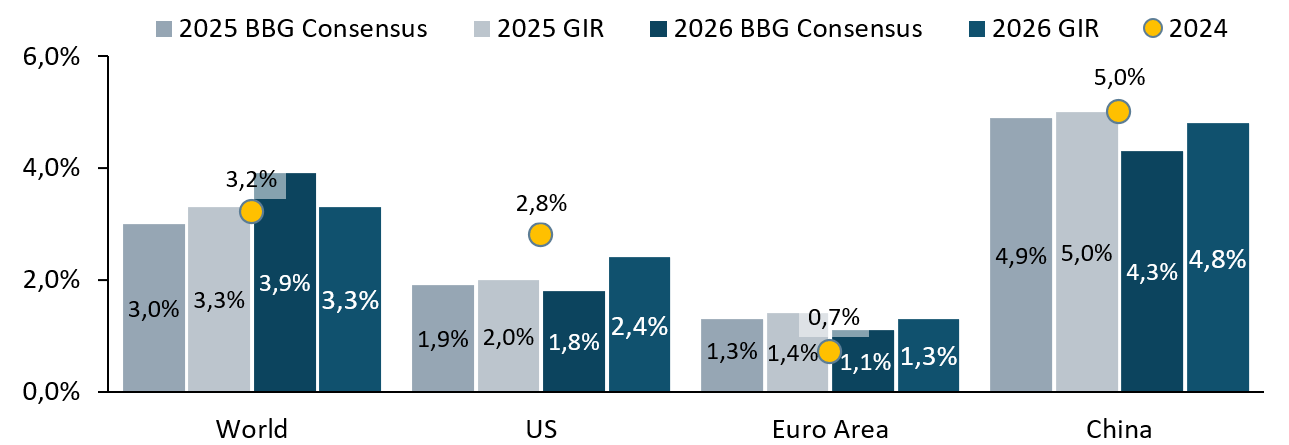
Global growth is expected to improve in 2026, driven by the looser fiscal policy in the US and Germany, significant investment in AI and the favourable financial conditions, although the risks in the US labour market persist.

Expected real GDP growth in 2025 and 2026

Sources: Goldman Sachs and Bloomberg. The GDP growth in the US, the eurozone and China in 2024 are confirmed figures, while the one for the world (weighted by the Purchasing Power Parity) is based on the expectations for the GIR. 

Growth in the US is expected to slow in Q4 2025, reflecting the short-term risks stemming from the weakening labour market and the continued negative impact of the government shutdown and the higher tariffs. However, the outlook for 2026 is positive, with an expected upturn in growth thanks to public spending, increased investment in AI and the more favourable financial conditions.

In the eurozone, the fiscal shift to aid growth, reduced trade uncertainty, stable real household incomes and the resilient labour market are driving the optimism about growth in Q4 2025 and 2026.

China is expected to expand by 5% year-on-year in 2025, thanks to the resilient growth of its exports and advanced public spending. Although the economy is slowing after a strong first half of the year, the magnitude seems smaller. The recent policy developments also suggest that the Government will prefer to delay any further positive boost for the stimulus measures until early 2026.

Which options should be considered when the markets display high valuations?

In 2025, the major stock indexes, including the S&P 500 in the US, the STOXX 600 in Europe and the Nikkei 225 in Japan, have set new all-time highs. The spreads for fixed income remain at historically low levels. When traditional investments appear expensive, it’s crucial to adopt a strategic approach that goes beyond pursuing the benchmarks.

In changing market environments, it’s often useful to analyse the combination of stocks and bonds and adapt them to the circumstances at any given time.

Diversification (both internationally and across the asset classes) is also vital, bearing in mind options such as the private markets, which can deliver better risk-adjusted returns. Moreover, with changing correlations between assets and changes in the dollar’s dynamics, the currency hedging strategy is an important consideration.

Equity

In 2026, equity will be shaped by much greater dispersion, a multi-polar environment and a set of structural catalysts (AI, reindustrialisation, defence, global CAPEX) set to provide highly diverse opportunities according to the regions, sectors and styles. Active management will become key in this setting.

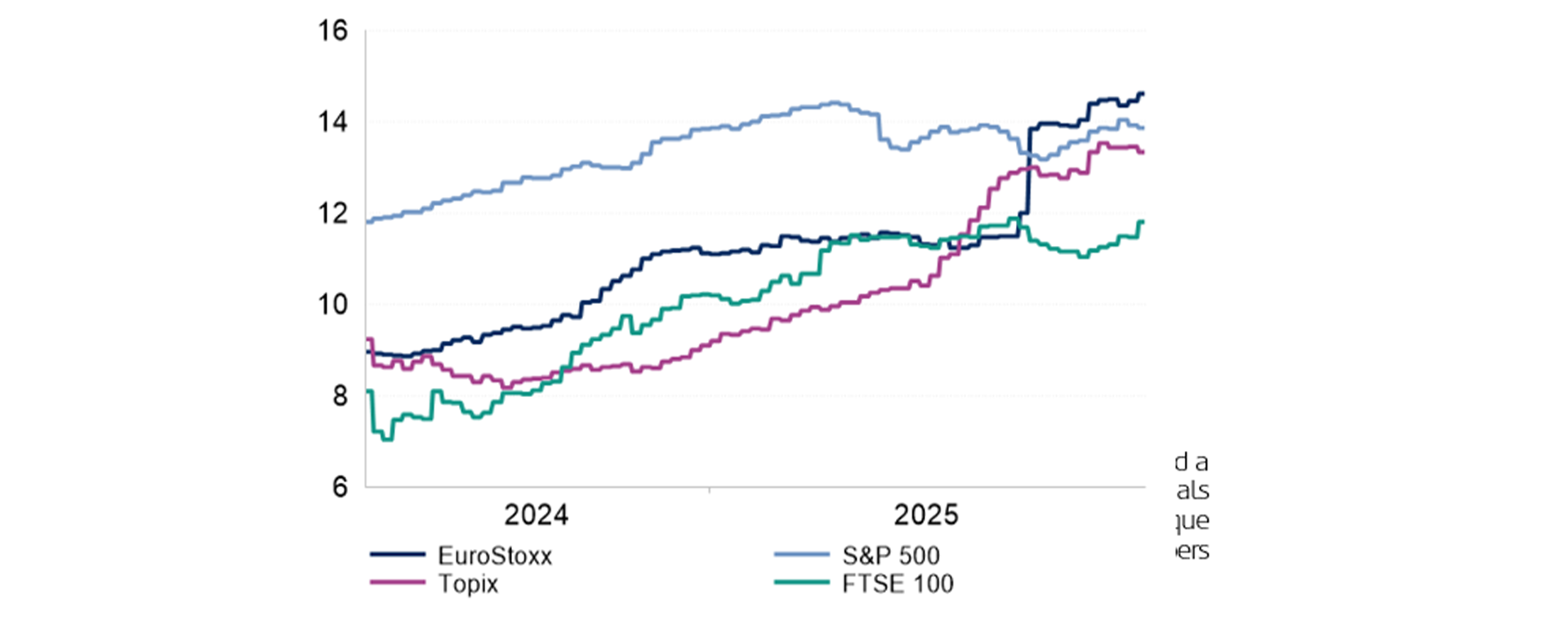
Faster rise in earnings (EPS) across all the regions

Sources: Dallas Fed, Revelio Labs, ADP, Refinitiv, IBES, Bloomberg and Multi Asset Solutions Goldman Sachs.

This positive macro environment is reflected in extremely solid profit growth across all the regions, albeit with stringent valuations, particularly in the US. The markets are discounting a price for perfection (valuations that discount the best scenario) for the US that may lead to a correction with the potential to spread globally in the coming months.

Europe: the potential of structural re-rating. Defence, energy, infrastructure and reindustrialisation as engines. Deep discount valuations with respect to the US. Expectations that growth in 2026-27 will recover and reduce the gap with the US.

Emerging economies: an attractive discount and favourable macro support. These are listed with a 40% discount vis-à-vis the US. Favoured by the weaker dollar, more controlled inflation, low valuations and solid earnings. India and China stand out as centres of attention.

Fixed income

The carry as a core pillar of 2026.
Fixed income provides a technically and fundamentally attractive setting, but the fiscal environment (particularly in the US and France) may bring long-term volatility.

  • United States: a probable cut in December and two further ones in 2026 if the labour market continues to weaken.
  • Europe: the ECB could keep its rates constant but, if inflation falls below the 2% target, the cuts could return. Expansionary taxation in Germany may put pressure on the long side of the curve.
  • Emerging markets: the emerging debt markets are being favoured by the weaker dollar, lower oil prices, looser local monetary policies and stronger sovereign and corporate balance sheets than in previous historical periods.

Short-term hedges continue to serve as an excellent option in periods featuring weak growth, while long-term ones are more vulnerable to fiscal risks, inflation expectations and a greater supply of sovereign debt.