
#MoraBancExperts

Artificial intelligence and the labour market: a threat or an opportunity?

MoraBanc 2026-05-12

The emergence of artificial intelligence (AI) is beginning to transform the global labour market, and the United States is one of the first major laboratories for this change. Although massive disruption has not yet occurred, experts agree that the next decade will be decisive in understanding the extent to which AI will change the way we work, what job profiles will be most in demand, and even the evolution of the economy itself.

According to Goldman Sachs Research, up to 300 million jobs in the world, to a greater or lesser extent, are exposed to Al-linked automation processes. However, this does not necessarily mean an equivalent destruction of jobs. Economic history shows that each technological revolution eliminates certain jobs, but also creates new ones.
The first effects are already visible

The impact of AI is already being felt, especially in sectors linked to technology, knowledge and creativity. Profiles such as programmers, graphic designers, call centre workers or consultants are beginning to see how some tasks can be partially automated thanks to generative AI tools. However, the aggregate impact on the American labour market is still limited. Employment data does not reflect, for the moment, a profound structural change. Experts believe that the process will be gradual and that companies will adopt AI progressively over approximately the next ten years. It is estimated that between 6% and 7% of workers could be displaced during the transition period. If this adjustment occurs gradually and in orderly fashion, the effect on unemployment would be relatively moderate. On the other hand, if the adoption of AI accelerates very quickly, the impact on employment could be heavier.

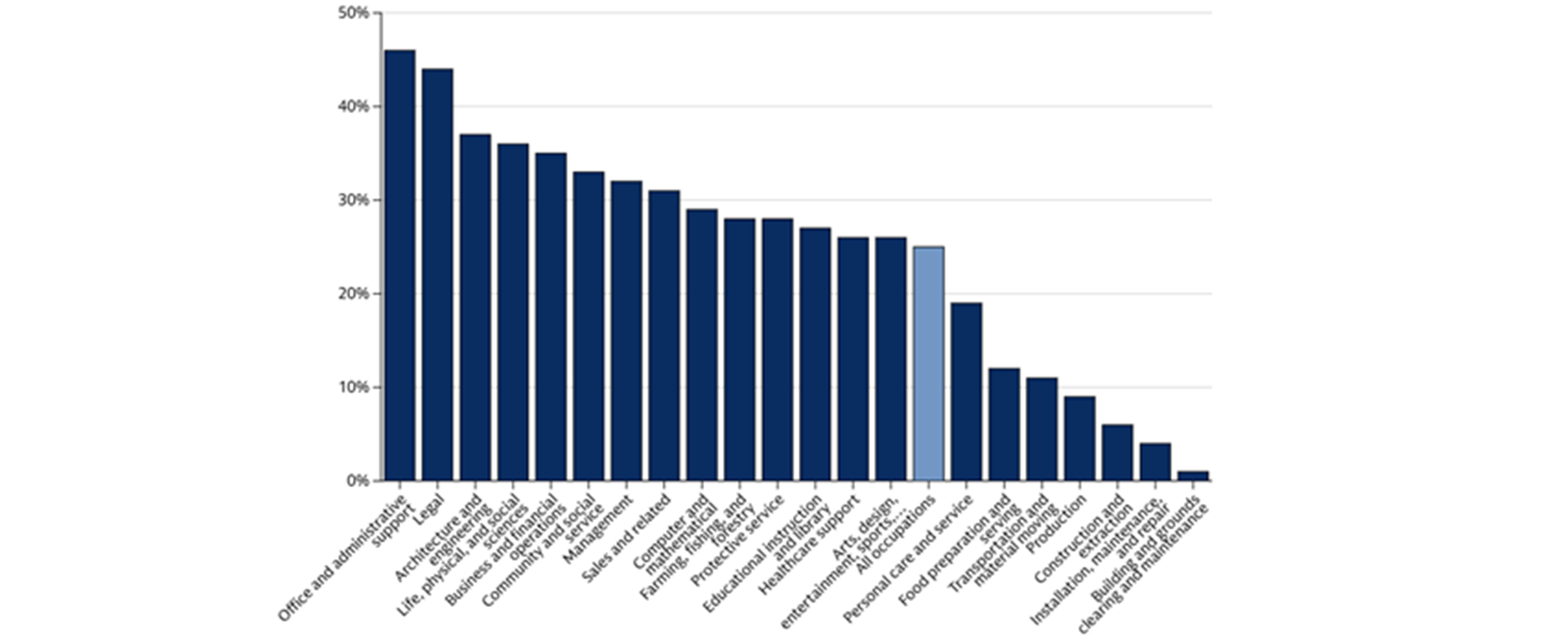
AI could automate 25% of all work tasks in the United States

Percentage of employment by profession exposed to automation by AI in the United States

Source: Haver Analytics and GS Research

The paradox: AI will also create jobs

Despite initial fears, AI is also generating new job opportunities. In fact, a significant part of the current boom is focused on all the infrastructure necessary to make this technological revolution possible.

Data centres, power grids, and new energy infrastructure will require hundreds of thousands of workers. In the United States, it is estimated that just to meet the increased energy demand associated with AI, it will be necessary to hire nearly 500,000 new workers before 2030.

This is driving the demand for technical and industrial occupations such as electricians, engineers, construction workers or air conditioning specialists. Since 2022, jobs linked to data centre construction have increased by more than 200,000.

In parallel, new professions related to AI itself will also appear. Companies will need workers with specific technological knowledge, and new specialisations will emerge in sectors such as health, education or professional services.

Young workers, among the most exposed

Experts point out that younger professionals, especially those now joining the administrative, technological or content creation sectors, could be the most affected by the first deployments of AI.

Many of the entry-level tasks in the job market—basic writing, simple data analysis, administrative support, or content creation—are precisely some of the easiest to automate.

This could force new generations to adapt more quickly, acquiring technological skills and more specialised or hard-to-replace skills.

A transformation with many unknowns

The big question is just how quickly this transformation will progress. Experts insist that there is still a great deal of uncertainty about how the real impact of AI on employment will evolve.

As has happened in other technological revolutions, it is likely that certain sectors will suffer more than others, but also that new needs and new professions will appear that do not yet exist today.

In any case, AI aims to become one of the main factors that will shape the evolution of the labour market and the global economy in the coming years.